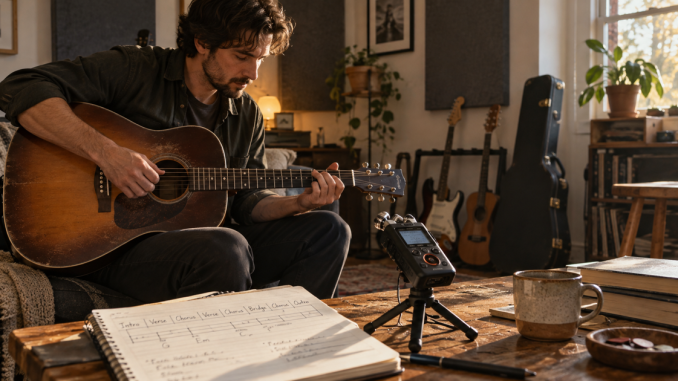
A preproduction demo is a rough, complete recording that helps you decide how the song should work before expensive or difficult-to-repeat recording begins. It does not need release quality. It needs to reveal the arrangement, tempo, key, transitions, and performance questions clearly enough that everyone can prepare for the same song.
That distinction can take pressure off. You are not trying to make the record twice. You are giving the song a full test while changes are still cheap.
Decide what the demo must answer
Start with the uncertainty that could waste the most time later. Perhaps the second verse feels too long, the chorus arrives without enough lift, the bridge changes the emotional direction, or the ending has never been settled. Write those questions down before you press record. A demo with a purpose teaches you more than a nicer recording made without one.
Record the whole song at a useful level of detail
Capture a complete performance from count-in through the final decay. Use the simplest setup that preserves the decisions you need to hear. A voice and one instrument may be enough for a writing question. A band may need a room recording to judge groove and transitions. Programmed parts can be useful when they represent a real arrangement choice, but do not spend hours polishing sounds that are not part of the question.
If the demo will be shared, give it a clear date and version name. The same discipline used to organize music files before sharing them keeps an old arrangement from quietly becoming the current one.
Listen for relationships, not isolated perfection
On the first playback, do not stop at every missed note. Listen for the larger movement. Does the opening establish the song soon enough? Does each section make the next one feel necessary? Does the vocal sit in a comfortable and expressive range? Does the ending feel chosen?
Then listen again for practical demands: instrument changes, overdubs, harmony entrances, sound-design moments, tempo transitions, and anything a player must prepare. Separate a writing problem from a performance problem and both become easier to solve.
Change one meaningful thing at a time
If you shorten the verse, change the key, replace the groove, and rewrite the bridge at once, the next demo cannot tell you which decision helped. Make one meaningful version, label it, and compare complete performances. Keep the earlier version. A rejected idea can still teach you why the chosen one works.
Turn the approved demo into a session map
When the song holds together, mark the section order, working tempo, key, count-in, important cues, reference sounds, and unresolved choices. Note who is responsible for each part and which decisions should remain open for the session. The map should prepare the people, not trap them.
If outside musicians, an engineer, or a producer will participate, ask what they need before you deliver files. After the arrangement is settled, the published guide to preparing stems for mixing can help with a later and more technical handoff. A preproduction demo has a different job: it proves that the song is ready to enter that process.
Use the record-tomorrow test
Ask whether every participant could hear this demo tonight and know what to prepare for tomorrow. If the form, feel, entry points, and open questions are clear, the demo is doing its work. If the only thing you want to improve is its polish, stop. Save that energy for the recording that is meant to last.
Are you an independent musician working to build a real career from your music?
As a musician, you do everything a business owner does – you create and deliver products, manage schedules, handle finances, and do everything else a business owner does. We believe you deserve to be paid like one… and Music Sense can make it happen.


Be the first to comment