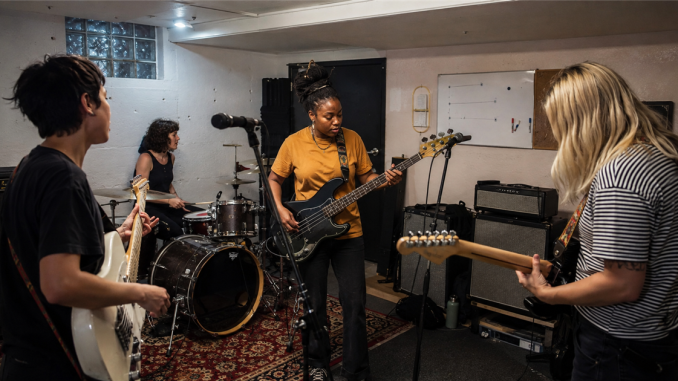
A productive band rehearsal has a defined job, a short priority list, and enough uninterrupted playing time to solve the musical problems that matter most. It is not a meeting with instruments in the room, and it is not a full performance repeated until everyone is tired.
Rehearsal time is expensive even when nobody rents the room. Every musician has prepared, traveled, carried equipment, and set aside other work. Respect that investment by deciding what the band needs before the first cable is plugged in.
Name the result before the rehearsal
“Practice the set” is too broad. Choose a result you can hear or observe:
- lock the ending of three songs;
- rehearse transitions for a 45-minute set;
- choose the arrangement for one new song;
- test vocal keys and harmonies; or
- prepare two songs for a recording session.
Send the song list, recordings, charts, keys, and special notes early enough for individual preparation. Rehearsal is where the group puts prepared parts together. It should not be the first time every member discovers the material.
Put the hardest work near the front
Warm up, then address the problem that needs the most attention while ears and patience are fresh. Running familiar songs for an hour can feel satisfying, but it leaves the difficult transition waiting for the final ten minutes.
When something breaks down, shorten the loop. Start a few measures before the problem, identify the cue, repeat the section, then place it back inside the full song. Playing the entire song again is not always practice; sometimes it is a way to pass the problem without studying it.
Use language the whole band can act on
“Make it better” gives nobody a task. Say what you hear and where it happens: the second chorus speeds up, the vocal entrance is covered, the ending cue is unclear, or the guitar and keyboard are occupying the same space.
Then decide what will change. One person should capture the decision so the band does not solve the same problem next week.
Rehearse the spaces between songs
The audience experiences the whole performance, including tuning, count-ins, instrument changes, introductions, and silence. If you are preparing a show, rehearse those moments. This is part of giving listeners a reason to return: the audience remembers how the whole set felt, not only whether each song was technically correct.
Run the set with a clock at least once. A list that looks like 45 minutes can become longer when applause, speaking, and transitions are included.
Record for diagnosis, not judgment
A simple room recording can reveal tempo drift, balance, unclear endings, and long pauses that were hard to notice while playing. Listen for the rehearsal's stated result. Don't turn every playback into a referendum on the band's worth.
End by agreeing on three things: what changed, what each person must prepare, and what the next rehearsal must accomplish. That small closing discipline carries the work forward.
Try the twenty-minute test
At the end, ask whether the band can hear meaningful improvement in the priority material from the first twenty minutes to the last twenty. If not, the next rehearsal needs a smaller target, clearer preparation, or a better way to isolate problems.
The goal is not to leave exhausted. The goal is to leave more ready.
Are you an independent musician working to build a real career from your music?
As a musician, you do everything a business owner does – you create and deliver products, manage schedules, handle finances, and do everything else a business owner does. We believe you deserve to be paid like one… and Music Sense can make it happen.




Be the first to comment