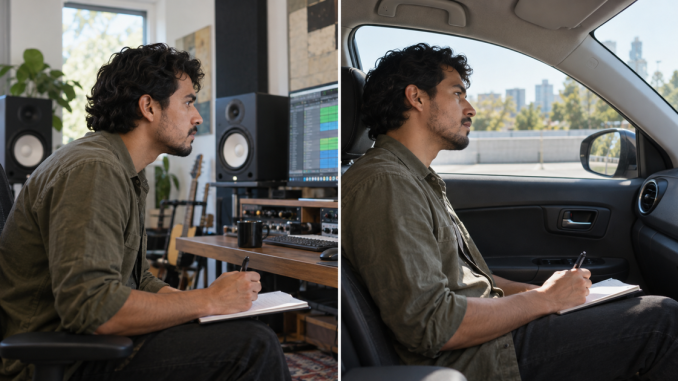
To compare a mix on different speakers, play the same approved version at sensible levels, listen for the same musical questions, and write down only problems that repeat or materially affect the song. The goal is not to make every device sound identical. That is impossible. The goal is to learn whether the important relationships survive ordinary listening conditions.
Without a method, each new speaker can create a new correction. Soon the mix is reacting to rooms and devices instead of serving the music.
Choose a small listening set
Use the main trusted monitoring environment, one or two familiar everyday systems, and perhaps a single small speaker that exposes balance at low detail. A parked car can be useful if you know it well. Headphones can reveal noises and placement, but they are another perspective, not a verdict.
Do not collect devices merely to feel thorough. Choose systems that represent real listening contexts or answer a known question.
Keep the source and level controlled
Confirm that every system is playing the same file without an accidental equalizer, enhancement mode, normalization change, or alternate version. Compare at comfortable, repeatable levels. Louder often feels fuller and more exciting, which can disguise a weak comparison.
Clear filenames matter here. Follow the published system for organizing music files so the test does not become a comparison of different mixes.
Ask the same questions everywhere
- Can you follow the lead element without strain?
- Does the rhythm relationship still feel intentional?
- Do important words or melodic turns disappear?
- Does the low end support the song or obscure its motion?
- Do section changes retain their intended impact?
- Does anything become painful, distracting, or unexpectedly absent?
These are musical questions. “The car has more bass than the studio” may describe the car more than the mix.
Learn the system before blaming the mix
Play a few well-known reference recordings through the same device. If every record becomes boomy in that car or thin on that speaker, the system has revealed its character. Your mix may still need work, but one unfamiliar playback is weak evidence.
Record observations before proposing changes
Write the location, timestamp, observation, and consequence. Then compare notes across systems. A lead vocal that vanishes in the same chorus on several familiar systems deserves attention. A hi-hat that sounds different on one tiny speaker may simply be that speaker.
When you send a revision request, use the focused process in the mixing-preparation guide and keep technical delivery separate from artistic feedback.
Take breaks between comparisons
Rapid switching can turn attention into fault-finding. Listen to the complete song, step away, and return with one question. If you have been reviewing for a long time, stop before making a permanent decision. Fatigue is not a more honest set of ears.
Use a repeatability rule
Change the mix when the observation repeats, matters to the song, and can be explained clearly. Do not change it merely because a device has its own sound. Translation is not sameness. A successful mix lets the lead, groove, words, dynamics, and emotional direction remain understandable even while every playback system colors them differently.
Are you an independent musician working to build a real career from your music?
As a musician, you do everything a business owner does – you create and deliver products, manage schedules, handle finances, and do everything else a business owner does. We believe you deserve to be paid like one… and Music Sense can make it happen.



Be the first to comment