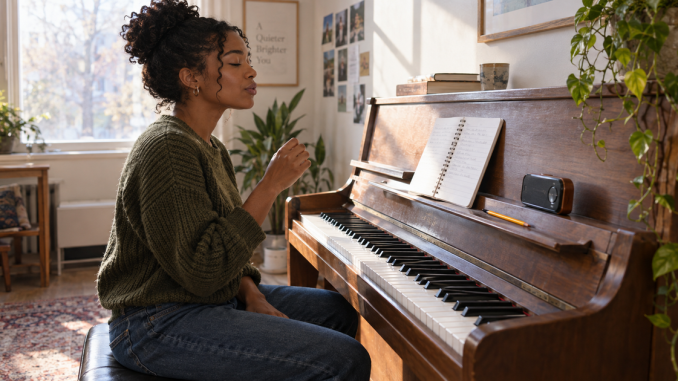
To learn a song by ear, start with a short phrase you can remember, work out its rhythm and shape, and then find its notes on your instrument. Trying to discover everything at once makes it hard to tell whether you’re missing the pitch, the timing, or simply the phrase itself.
If you can play a simple melody but get lost when several parts move together, give yourself a smaller listening task. You don’t need to hear the whole song immediately. Start with one piece you can remember clearly enough to test.
Decide which part you’re learning
Choose one recording and one part: the sung melody, the bass line, or a particular instrumental figure. Different performances may change the key, embellishments, or form, so switching versions halfway through can make a correct observation seem wrong.
Listen once without playing. Find where your chosen part enters and where the first phrase ends. Start with a phrase short enough that you can hum it back after stopping the recording. If you lose its ending, shorten it again. Remembering the sound is part of the work, not a delay before the real work.
Find out what you actually don’t know
Tap the pulse and speak or clap the phrase’s rhythm. Then hum its outline. Does it move upward, downward, repeat a pitch, or leap and return? You can know those things before you know the note names. Berklee’s ear-training curriculum likewise treats rhythm, melodic recognition, and transcription as connected skills.
Now use your instrument to find the starting note. Play a candidate, listen back, and compare. Once that note matches, test the next note in relation to it. If the rhythm works but a leap doesn’t, isolate the leap. If the pitches seem right but the line feels different, check where notes begin and how long they last.
For example, suppose a four-note phrase sounds wrong only at the end. Replaying all four notes ten times may reinforce the mistake. Hold the third note in your memory, listen to the fourth, and test whether it rises, falls, or stays put. Then restore the rhythm and hear the pair in context.
Check the phrase, then join it to the next one
Play your phrase with the source at a comfortable listening level, then play it alone. Matching the recording tests accuracy; playing alone tests whether you’ve learned it or are relying on the recording to pull you along. Write down note names, notation, or a reminder that you’ll understand tomorrow. Mark uncertain notes as uncertain.
A slower playback setting can help with a dense passage, but confirm that it preserves pitch. If it changes pitch, your comparison with the original recording won’t mean the same thing. Return to normal speed before deciding the phrase is learned.
Learn the next phrase in the same way, then practice the connection across the boundary. A phrase can be correct in isolation while its entrance is late. If that connection becomes the sticking point, our guide to practicing a difficult passage explains how to work on the actual trouble spot.
Follow the part through the rest of the song
Once you have a few phrases, note the order they occur in: verse, chorus, another verse, or whatever form this song uses. Listen to each return before assuming it’s identical. The last chorus may change a note or add a pickup. Mark that difference, then play the part from beginning to end so you can hear whether the phrases and entrances still work together.
When you can’t reliably hear the direction between two notes, a teacher can help you build that particular skill. When the part is simply buried, a clearer authorized recording or score may be more useful than more guessing. Before you stop, play the phrase once without the recording and write down the note or entrance you still need to check. Tomorrow, you’ll know where to pick up.



Be the first to comment