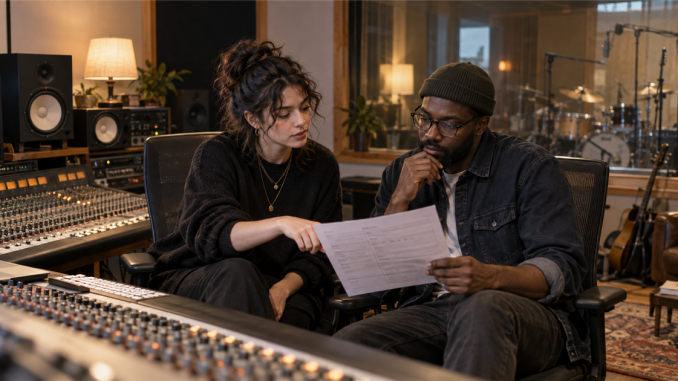
The best recording studio is not automatically the largest room, the longest equipment list, or the lowest hourly rate. It is the place where the people, space, workflow, and agreement fit the job your music actually needs. Define that job first, and the studio comparison becomes much clearer.
Write the session job before you request prices
“Record my project” is too broad to compare honestly. A solo vocal overdub, a live rhythm section, a grand piano performance, and a full-band tracking day ask different things of a room and crew. Write a short brief with the number of songs, performers, instruments, likely recording method, current preparation, and the result you expect to leave with.
If the arrangement is still moving, solve that before expensive decisions multiply. A productive band rehearsal can expose arrangement and transition questions that do not need studio time.
Compare the person, not only the room
Ask who will engineer the session and how that person normally works. You are listening for communication fit as much as technical vocabulary. Can the engineer explain the plan plainly? Do they ask about the music before proposing a setup? Will they make decisions, wait for yours, or share that authority? None of those approaches is universally correct. The mismatch is what creates trouble.
Request relevant work samples, then listen for the kind of problem you need solved. A beautiful acoustic recording does not prove the same fit for a layered electronic production. Credits and impressive clients may be useful context, but they do not replace a conversation about your session.
Inspect the practical room
Find out whether all performers fit comfortably, whether sightlines and isolation suit the planned performance, and whether load-in, parking, accessibility, restrooms, climate, and session hours work for the people involved. If a particular piano, amplifier, microphone, or monitoring arrangement is essential, confirm the exact item and its availability rather than assuming it from an old photograph or gear list.
Ask for the real total, not just the hourly rate
Clarify what the quoted time includes: setup, line check, recording, breaks, file transfer, rough mixes, cleanup, and overtime. Ask whether an assistant, instrument rental, tuning, storage drive, editing, mixing, or tax is separate. Then estimate the complete session rather than multiplying the headline rate by the hours you hope to record.
A cheaper room can cost more when the setup fights the arrangement or the handoff is incomplete. A higher rate can still be poor value when the studio supplies services you do not need. The useful comparison is total cost against the defined job.
Confirm the workflow and handoff
Before booking, agree on who approves takes, how files are named, what backups exist during the session, and what you receive afterward. If the work will move elsewhere, prepare for that handoff now. The same file discipline used to prepare clear stems for mixing begins with knowing what the next person will need.
Ask how long files remain available after the session and who is responsible for preserving them. A studio backup is not necessarily your archive. Leave with your own organized copy and a record of the versions everyone approved.
Use one final fit test
After the visit or call, ask: “Can I picture this specific session moving from load-in to file handoff here without relying on an unspoken assumption?” Write down any assumption that remains. Then get rates, dates, cancellation terms, deliverables, and responsibilities in writing before money changes hands.
You are not buying a room for a few hours. You are choosing a working relationship around a musical result. A clear session brief lets the right studio show you why it fits—and gives you a fair reason to decline the one that does not.



Be the first to comment