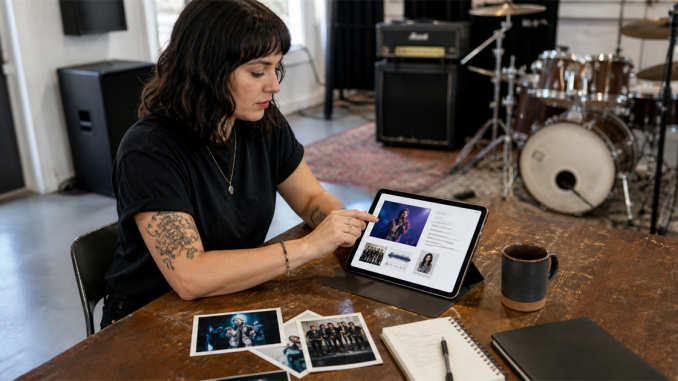
A useful electronic press kit gives a booker, journalist, radio host, or other music professional one dependable place to understand your act and decide what to do next. It is not a storage closet full of files. It is a guided introduction built for someone who may have only a few minutes.
Musicians often treat the EPK as a collection project: add the bio, every photo, every song, every quote, every link. From the receiving side, more material can create more work. Your job is to make the important decision easier without pretending the decision has already been made.
Build the kit for one opportunity
Before choosing sections, name the person and decision. A venue is checking whether you fit a bill and can perform reliably. A writer is looking for a story, accurate facts, and usable assets. A radio host needs a suitable track, correct information, and an easy way to contact you.
You can keep one master EPK, but lead with the material that answers the current opportunity. Do not make every recipient dig through the same general package.
Put the decision material first
- One-line identity: artist name, musical territory, and the clearest reason this act belongs in the conversation.
- Best listening entry: one or two tracks that represent the current direction.
- Short bio: an accurate, specific introduction rather than a complete history.
- Strong visual proof: a small set of current press photos and, when relevant, a live-performance video.
- Credible context: selected coverage, verified shows, or other facts that help the recipient evaluate fit.
- Clear contact: the person to reach and the kind of request that person handles.
Use one link that works without a login
A web page is usually easier to maintain than a large attachment. Keep download options for high-resolution photos, a stage plot, or other working files, but let the recipient preview the music and essential facts before downloading anything.
Test the page on a phone, in a private browser window, and on a slower connection. Play every track. Open every download. Send the contact form or email link to yourself. A polished kit with one broken gate is still a broken kit.
Match the claims to the assets
If the EPK says the act delivers a powerful live show, include current live proof. If it describes a new musical direction, lead with music from that direction. If you mention press, identify the publication and link to the coverage when possible.
Do not fill an early-career EPK with empty sections. “Press coming soon” and invented superlatives do not make the artist look established. A focused presentation of real work is more professional than pretending a larger career already exists.
Keep radio needs separate from booking needs
Requirements vary. KEXP’s current submission guidelines, for example, request streaming and WAV download links, artist and member information, pronunciation help when needed, focus tracks, release dates, and clean edits for content issues. That is a useful reminder to follow the exact recipient’s instructions rather than assuming one package fits every station.
Make a two-minute test
Give the link to someone who has not helped build it. Ask that person to spend two minutes and then tell you who the artist is, what the music sounds like, which track to play first, what opportunity the act fits, and how to make contact. Every answer they cannot find reveals work the recipient would have to do.
Your EPK is ready when it represents you honestly, serves a defined decision, and removes avoidable friction. Keep the master assets organized, review the public page before each pitch, and update facts when the project changes.
Are you an independent musician working to build a real career from your music?
As a musician, you do everything a business owner does – you create and deliver products, manage schedules, handle finances, and do everything else a business owner does. We believe you deserve to be paid like one… and Music Sense can make it happen.



4 Trackbacks / Pingbacks