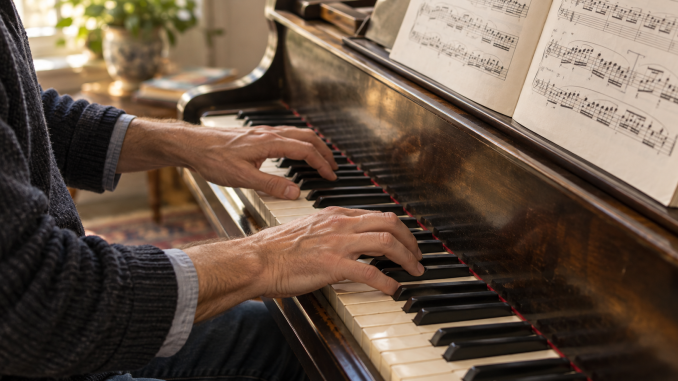
To practice a difficult musical passage, find the smallest point where control breaks down, slow it enough to understand the problem, and then reconnect it to the music before and after it. Count success as a repeatable, musical result, not one lucky run at full speed.
If the same two bars fall apart every time, playing the whole piece again can feel productive because you're working hard. But most of that time may be spent on music you already know. The useful question is more precise: what changes at the moment you lose control?
Locate the first uncertainty
Start just before the trouble and notice where the first mistake occurs. It may be earlier than the note you keep blaming. An awkward preparation, unclear rhythm, or inconsistent fingering can leave the next movement with nowhere comfortable to go.
Choose one thing to observe. Can you count the rhythm without playing? Can you name or hear the notes? Does the movement work slowly? Do you know the fingering, sticking, bowing, or breath plan appropriate to your instrument?
Those questions separate different practice jobs. If you don't understand the rhythm, repeating the finger movement faster won't explain it. If the notes are understood but the transition is uncertain, focus on how you enter it.
Berklee's practice exercises provide instrument-specific material. Use material suited to your instrument and level; a general practice method doesn't replace a teacher's judgment about technique.
Work on a small piece with a real entry and exit
Take a short span containing the difficulty plus enough music on either side to include the approach and landing. Slow it until you can deliberately control the chosen detail. Keep the rhythm and the musical intention recognizable.
Suppose a piano passage breaks at a position change. Starting every repetition on the note after the change may make that note feel secure while leaving the change itself unpracticed. Include the preceding movement. Then include the next beat, so the landing leads somewhere.
After a controlled repetition, pause long enough to notice what worked. After an uncontrolled one, change the conditions: reduce the tempo, shorten the span, or clarify the movement. Repeating the same uncertainty without an adjustment isn't a useful measure of persistence.
You can set a modest local target, such as a few controlled repetitions with the same rhythm and movement. Treat that as your practice check, not a universal scientific threshold. Raise the tempo in manageable steps only while the result remains dependable.
Put the passage back where it belongs
Now begin farther back. The difficult section may work alone and still fail after the previous phrase because your attention, hand position, or breathing arrives differently.
If it breaks again, you've learned something. Practice the connection rather than declaring the isolated work useless. Gradually widen the span until the passage belongs to the phrase, then test it in the piece.
A short recording can help you hear whether the rhythm and expression survived. Listen for the specific goal you chose, not every flaw in the performance at once. When the passage supports a live show, return it to the context of your setlist instead of treating technical speed as the whole result.
Finish by recording a useful starting point for tomorrow: the span, a controlled tempo if relevant, the problem you isolated, and the next check. Stop if playing causes pain; persistent pain or a technical problem you can't resolve warrants appropriate professional help.
The aim is to arrive at the passage knowing what happens next. Confidence grows from that understanding, and you can practice it in a much smaller space than the entire piece.


Be the first to comment